Does Microsoft Copilot speed up R&D innovation?
Let me start with what I am not saying. Microsoft Copilot is a useful tool. It saves office workers hours of manual work. It finds documents, summarises meetings, drafts emails and prepares briefs. It is not perfect. But it works within access limits and on messy data, and it still does a good job.
The problem starts when it is bought with the wrong expectation. Many R&D leaders I speak to want one thing above all: faster innovation. Copilot may not be the right tool to deliver that.
This is not a failure of the tool. It is a mismatch between what the tool does and what the goal requires.
What is the Theory of Constraints?
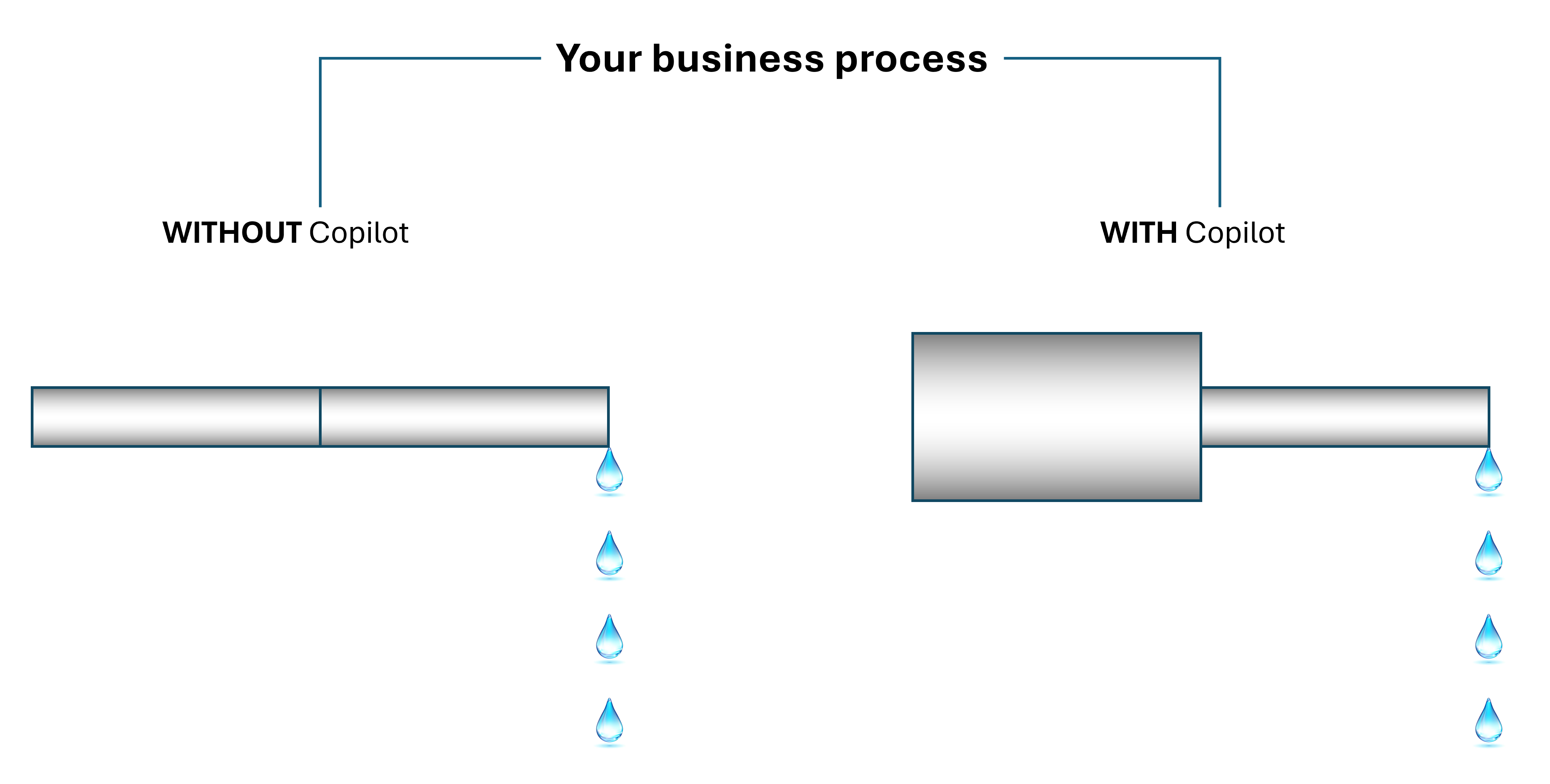
The Theory of Constraints comes from Eliyahu Goldratt. Its point is simple. Every process has a bottleneck. That bottleneck sets the speed of the whole system. Speeding up any other step does not make the system faster.
You will know these examples from any large organisation:
- You produce the meeting takeaways in seconds, but the decision sits on someone's desk for three weeks. No acceleration.
- You identify lead candidates in seconds, but laboratory testing still takes months. No acceleration.
- You draft the perfect proposal in an hour, but the procurement cycle takes several weeks. No acceleration.
Goldratt gave five focusing steps. Identify the constraint. Exploit it. Subordinate everything else to it (let it set the pace). Elevate it. Then repeat, because the constraint will move. People often miss the third step. Speed up work upstream of the bottleneck and you gain nothing. Worse, you build a longer queue in front of it. More proposals, written faster, just means more proposals waiting at procurement.
Why doesn't Copilot reach the core R&D process?
In any organisation, a few digital initiatives create most of the value. They are the ones that touch the core process. Many smaller initiatives support the processes around that core. Each one matters less. Together they still matter.
Copilot belongs in that second group. It helps with finding, summarising, drafting and preparing, the support roles in six things generative AI can do for R&D. These tasks surround the core work. They are not the core work.
In most R&D organisations, the core process turns prototypes into working products, or leads into hits. You choose ingredients, design prototypes, test to find the best one, and scale it up. This is where the time goes.
What is the bottleneck in R&D, and why does it stay untouched?
In many businesses, finding the bottleneck takes serious analysis. In R&D it rarely does. Everyone knows it is the long cycle of prototyping and testing. Months of trial and error, repeated for every project.
Copilot can find the relevant prior report in seconds. It can draft the experimental summary in minutes. The experiment still takes as long as it takes.
So the real question is not where the bottleneck is. It is why it stays untouched when everyone can see it. Three reasons come up again and again:
- The long tail is easy to buy and easy to measure. There is a vendor, a licence, a rollout plan and a dashboard of usage. The core bottleneck has none of these.
- Acting on the core takes a consistent and disciplined approach that is difficult to stick to. To cut experiments through prediction, you need historical data that was kept, easy to access and reusable. Most R&D organisations discover that their data was fit for one-time use but inadequate for reuse.
- Attention is finite. An easy win feels like progress. It takes the leadership focus that the harder problem needs.
So what do you get from Copilot?
If not acceleration, then what? Honestly, you get three real benefits. None of them is speed.
Productivity, but diffuse. Copilot accelerates tasks, not jobs. A scientist who saves forty minutes a day does not free up half a person. You cannot remove half a person from the payroll. The saving is spread thinly across hundreds of people. It only becomes value if someone decides what to do with it. The gains are largest in roles heavy on documents, such as regulatory, reporting and project management. But in R&D, most labour cost sits in lab work. Copilot never touches that.
Quality, within limits. No human can read hundreds of reports, patents and literature and synthesise them well. A tool that can gives scientists a better-informed starting point. A better starting hypothesis can mean fewer experiments. That is a real link to the bottleneck, though an indirect one. But it depends entirely on the data. Messy, unstructured reports with missing negative results and inconsistent units produce confident summaries that may be subtly wrong. Someone still has to check them. That eats into the time saved.
Knowledge reuse. If scientists can find and reuse prior work, they skip experiments that were already done. Cycle time is the number of iterations times the time per iteration. Fewer iterations means a shorter cycle. Again, this only works if prior work is easy to find and well structured.
The pattern is clear. Copilot's benefits are real for the individual. They are conditional for the system. I would treat it like email or laptops. It is a necessary part of modern working life, not a source of competitive advantage. Not having it would be odd. Having it does not make you faster than anyone else.
How can AI speed up R&D instead?
This is not an argument against AI. It is an argument about where you aim it.
Aim a large language model at emails and meeting summaries, and it speeds up the support process. Aim it at ten years of lab notebooks, reports and spreadsheets, and it can pull structured data out of narrative text. That structured data is the raw material for tools that do act on the bottleneck. These include recommender engines to select ingredients, predictive models to screen candidates on a computer (in silico), and optimisation across the whole portfolio. Some organisations also attack the bottleneck with high-throughput hardware. The two approaches feed each other. High-throughput data trains the models. The models tell you which experiments are worth running.
Whichever route you take, modelling skill is rarely the limit. The limit is whether past data was captured in a usable form. I wrote about what it actually takes to get to predictive R&D, and about turning messy lab notes into structured data, and the conclusion is the same each time: the data foundation comes first.
This is why the data foundation is a no-regret investment. It improves Copilot's synthesis. It makes automation more reliable. It enables prediction. Whatever you believe about Copilot's return, fixing the data pays off.
What should scientists do with the time Copilot saves?
If Copilot gives your scientists time back, what do they do with it? Left alone, it dissolves into the working day. Directed on purpose, it can fund the work that acts on the constraint. Good candidates include:
- Capturing data properly at the source. Use structured entries, consistent units and identifiers, and metadata. They make an experiment easy to find and model later.
- Validating extracted historical data. Automated extraction gets most of the way. A scientist who knows the context has to check it. Only they can do this.
- Thinking harder before experimenting. Time spent on hypotheses and experimental design can cut the number of iterations. That is the one way to shorten prototyping and testing without new hardware.
- Recording what failed. Negative results are the least documented asset in R&D. Predictive models need them.
- Sanity-checking the models. Domain experts choose the inputs and spot nonsense predictions. They decide whether a model is trusted or ignored.
- Engaging earlier with manufacturing and customers. Late surprises cause expensive extra iterations. Catching them early removes loops.
What should R&D leaders do about Copilot?
For R&D leaders, I would put it in three parts.
- Treat Copilot as table stakes. Roll it out sensibly if you have the budget. Focus on roles where the gains are largest. Do not build a business case that promises innovation speed.
- Do not let it become your digital strategy. The risk is not the tool. The risk is the attention it absorbs while the harder bottleneck waits.
- Aim the technology at the constraint. Invest in the data foundation and the predictive tools it enables. Use the time Copilot frees to help pay for it.
Copilot makes the work around innovation cheaper. It does not directly make innovation faster. Leaders who confuse the two end up with efficient scientists waiting on the same long experiments.
Frequently asked questions
Does Microsoft Copilot speed up R&D innovation?
Not directly. Copilot speeds up tasks such as finding documents, summarising meetings and drafting emails. But innovation speed is set by the slowest step in the core process, usually prototyping and testing. Copilot does not shorten that step, so the time from idea to product stays about the same.
What is the bottleneck in R&D?
In most R&D organisations, it is the long cycle of prototyping and testing. Teams spend months on trial and error for every project. To shorten it, you need fewer experiments, through predictive models, or faster experiments, through high-throughput hardware. Both depend on good historical data.
What is the Theory of Constraints?
It is a management idea from Eliyahu Goldratt. Every process has one slowest step, the bottleneck. That step sets the speed of the whole system. Speeding up any other step does not help. Real gains come from finding the bottleneck and improving it.
What benefits does Copilot give R&D teams?
Three real ones. It saves time on documents and admin, though the saving is spread thinly across many people. It can improve the quality of reports and literature reviews, if the data is good. It helps scientists find and reuse prior work. None of these shortens the innovation cycle.
What should scientists do with the time Copilot saves?
Use it on work that feeds the bottleneck. Capture data in a structured way at the source. Check data extracted from old reports. Record failed experiments. Spend more time designing experiments, so fewer are needed. This turns small, scattered savings into better data and fewer iterations.
Why does data quality matter for AI in R&D?
AI tools are only as good as the data under them. Messy notebooks and reports with missing results produce summaries that look confident but may be wrong. Clean, structured historical data also powers predictive models, which reduce experiments. Fixing the data helps every AI tool you use.