Every R&D organisation today faces an intense push toward digitalisation and artificial intelligence. Executive roadmaps promise a future powered by predictive analytics—where machine learning algorithms analyse years of historical lab data to recommend optimal formulations and process settings before a scientist even steps up to the bench.
While predictive analytics is an essential destination, getting there requires high-quality, disciplined data collected over years. Product names, chemical identifiers, measurement units, and analytical methods must be standardised across teams. Records must be stored digitally, and they must stay findable and reusable years later.
Building this data foundation is a mandatory, long-term endeavour, and many organisations find it harder and slower than expected. A 2025 survey of German chemical and pharmaceutical companies, published in the Journal of Business Chemistry, found that expectations for predictive analytics set in 2020 had run ahead of reality. Lack of data and insufficient digitalisation were among the obstacles it listed for AI adoption [1].
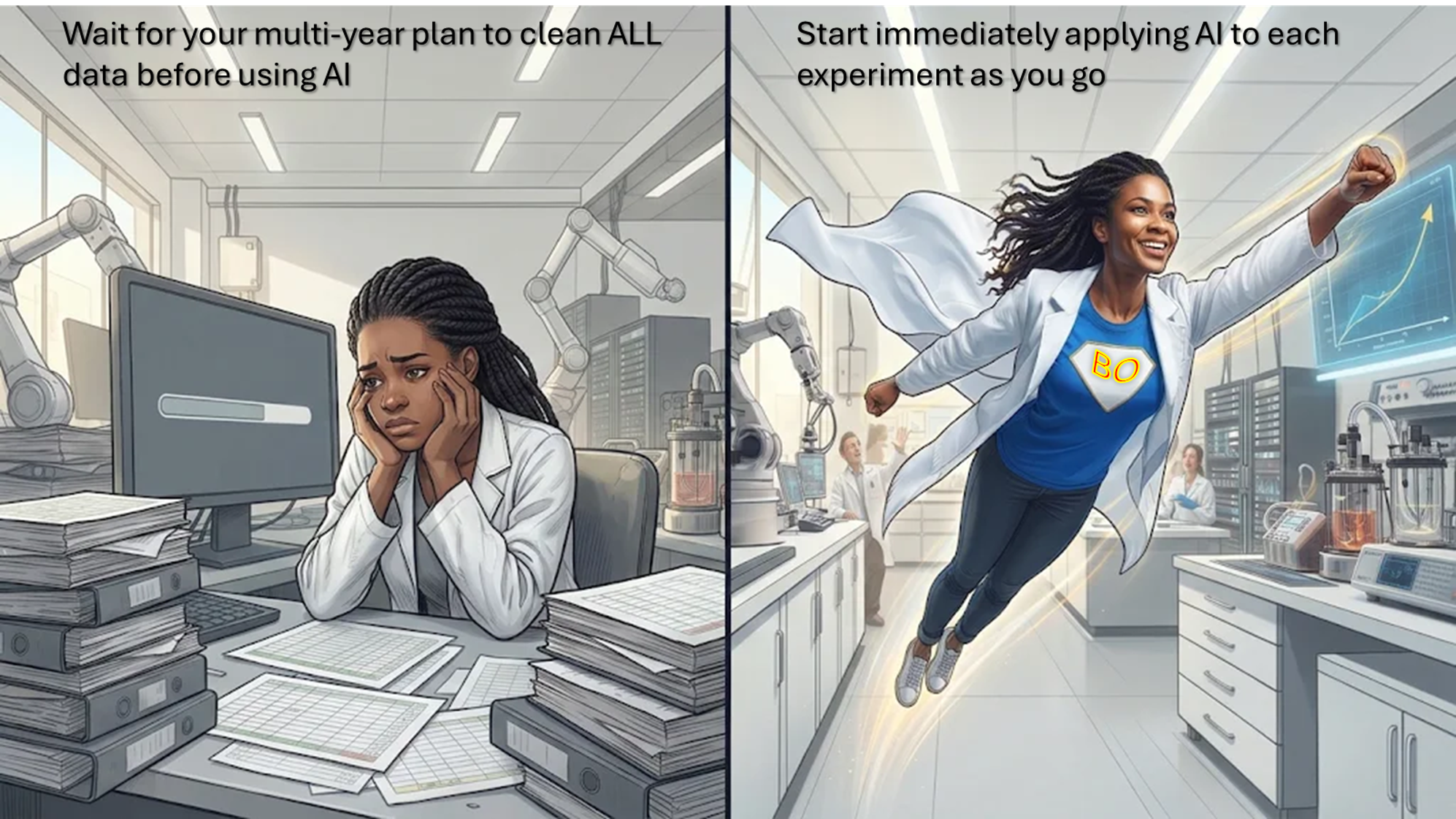
Here lies the dilemma: a data foundation takes years, but scientists have deadlines to hit this quarter. The good news is that a scientist does not have to wait. With Bayesian optimisation, a scientist can start on a live project within minutes, and the lab gets smarter with every experiment.
1. Why Bayesian optimisation works right now: the small-table advantage
The fundamental difference between classical predictive analytics and Bayesian optimisation comes down to data requirements:
- Predictive analytics relies on large historical databases to learn broad, generalised patterns across entire domains.
- Bayesian optimisation focuses on the project at hand. It optimises a specific formulation or process using a small table of 10 to 30 experiments.
Instead of demanding thousands of legacy records, Bayesian optimisation begins with the experiments a scientist was already planning to run. A scientist can load a table and get a first suggestion in the same session. Each result then updates the underlying model, making the next recommendation smarter. Benchmarks report the largest gains early in a campaign [2], so value begins accumulating in the first experiments, not after years of data curation.
Deploying it on daily bench work also builds the data foundation from the bottom up. Logging each trial in a clean, structured table produces standardised, high-quality data as a natural by-product. When many scientists work this way, the lab itself gets smarter: its data is cleaner, and its next project starts from a better place.
Leveraging past knowledge through transfer learning
When relevant data exists from a prior, similar project, Bayesian optimisation does not have to ignore it. Through transfer learning, the model can use that data to warm-start the search. Researchers at Merck KGaA argue that this lets teams put historical databases to practical use [3]. Rather than starting from a blank slate, the model starts from a rough picture drawn from past projects, which improves the first suggestions.
Scientists can leverage for instance their bench-scale work in efficiently optimising process on pilot or production scale. They can cut short the experiments needed to replace one ingredient by another in a formulation by learning from the experiments on the older ingredient.
Bayesian optimisation is already in use well beyond academic papers. Johnson & Johnson is collaborating on its use for reaction development [4], Merck KGaA, BASF and Evonik have each released or co-developed open-source Bayesian optimisation packages for chemistry [3, 5], it is a common engine in self-driving laboratories [2], and Lion Corporation reports cutting the development time of its toothpaste compositions by about half by combining it with its scientists’ expertise [6]. The Thoughtworks Technology Radar (November 2026) also notes its increasing use in real scientific and engineering work [7]. We also covered these kinds of cases in an earlier article in this series.
2. Why uptake remains slow: three hurdles
Despite these successes, recent reviews and tutorials describe Bayesian optimisation as underused in experimental labs. The obstacles are mostly practical, and they fall into three groups: data, understanding and access.
Data
There is a common misconception that a lab has to get its entire data organised before it can benefit from AI. In its broadest sense, and especially for predictive analytics, that is true. Bayesian optimisation though works on a different scale. As section 1 shows, it needs only a small table of 10 to 30 experiments from the project at hand, so a scientist can start now, and each tidy table adds to the data foundation along the way. Data is not a reason to wait.
Understanding
Bayesian optimisation still looks like a data-science tool. A 2025 tutorial for experimental scientists attributes the low uptake to limited awareness of the benefits, a perceived mathematical complexity and a steep initial learning curve [8]. The wider skills gap shows up in lab surveys: in the 2025 Pistoia Alliance survey of life science labs, 34% named a lack of skills as a barrier to AI, up from 23% a year earlier [9].
Trust is part of it. Bayesian optimisation is often seen as opaque [10], and scientists are accountable for the experiments they run, so an unintuitive suggestion costs real lab time. In a large Wiley survey of researchers, optimising experimental design was among the areas where respondents trusted human expertise over AI [11].
Practical guidance is thin as well. The same tutorial points to a lack of guidance tailored to non-specialists [8], and a 2026 materials-science paper attributes limited adoption to implementation complexity and a lack of domain-specific tools [12]. Setup choices matter: in an industrial plastics case, adding extra inputs drawn from expert knowledge impaired the optimisation in offline tests, until the problem was cut from 11 variables to 4 [13]. Real labs are also messier than the textbook, with categorical choices, constraints and several targets at once, and the authors of the open-source package BoFire note that existing optimisation software needs substantial adaptation before it works in industrial chemistry [5].
Access
Even a scientist who understands the method needs a way to use it. Most open-source frameworks, such as BayBE [3], BoFire [5] and BoTorch [7], are Python libraries that call for programming skills. Graphical tools exist, but they are research software: BASIL, for example, is a free desktop application, yet commercial users must negotiate a licence [14]. The alternative is an enterprise AI or R&D data platform with Bayesian optimisation built in, such as Uncountable [15] or Proxy Foods AI [16]. These enterprise platforms bring much more than optimisation, which is also why adopting them is a journey of months to years, and Uncountable, for example, builds its optimisation engine into the platform where an organisation’s R&D, quality and product data already live [15]. The data has to be organised first, and the first hurdle returns.
Such enterprise tools might be expensive for smaller R&D organisations. And even in those organisations that can afford it, the journey of months to years for rolling out an enterprise platform and cleaning historic data is daunting. So scientists simply wait.
3. Why we made this series
We made this series of articles to tackle the Understanding hurdle: to familiarise scientists with Bayesian optimisation, so that it stops looking like a data-science tool and becomes something a bench scientist can pick up and use. In the first two articles we discuss the challenges in product and process development, and the intuition behind Bayesian optimisation minus the complicated formulas.
4. Taking the first step: start in minutes
A smarter lab starts with a single scientist and a single project. We made Formulation Advisor freely available to remove the Access hurdle: there is no coding to learn and no platform to buy. Also the data in public version of Formulation Advisor is stored only locally on your machine, so confidentiality is assured.
Here is how to use Formulation Advisor effectively. Pick a live project that you are currently working on. Paste or upload a small Excel or CSV table of past trials (up to 10 independent variables and minimum of 5-10 rows of data), set one primary goal, and get the next trial to run. Once you conduct the trial, log the result, and ask for the next best trial to run. By taking these steps you quickly converge to the optimum by smartly learning from all your past experiments. After you enter your warm-up data, you can even get Formulation Advisor on your mobile phone that you can take with you to the lab. You can enter values on the go, and get the next trial to run. It cannot get easier than this!
The benefit of using Bayesian optimisation builds with every experiment. Every tidy table also adds to the lab’s data foundation, paving the way for the predictive analytics of tomorrow. The benefit also reaches beyond the lab. The optimum you find becomes the product and keeps paying back for as long as it stays in your portfolio, so the total value can be far larger than the experiments you save along the way. When many scientists work this way, the lab gets smarter.
Start with your own data with Formulation Advisor.
Want to go deeper?
To make Bayesian Optimisation work well, you need to properly select and define your variables and goals. If you want further tips and tricks with this for product and process development, request a copy of our practical guide here.
Frequently asked questions
Do I need years of historical lab data before I can use AI in R&D?
Not for Bayesian optimisation. Broad predictive analytics does need a long, clean historical foundation. Bayesian optimisation works from a small table of roughly 10 to 30 experiments on the project at hand, so a scientist can start on a live campaign without waiting for years of data curation.
How is Bayesian optimisation different from predictive analytics for formulations?
Predictive analytics learns broad patterns across large historical databases. Bayesian optimisation focuses on the current formulation or process: it updates after each trial and recommends the next experiment from that small project table. Both matter; they sit at different stages of a digital R&D journey.
How many experiments do I need to start Bayesian optimisation?
A small table of about 10 to 30 experiments from the live project is enough to begin. Benchmarks report the largest gains early in a campaign, so value can start accumulating in the first runs rather than after years of data work.
Why is Bayesian optimisation still underused in experimental labs?
The hurdles are mostly practical: a belief that data must be fully organised first, a perception that the method is opaque maths for data scientists, and limited access—most tools are Python libraries or enterprise platforms that take months to adopt. None of those has to block a single scientist with a small Excel or CSV table.
Can I try Bayesian optimisation without coding or buying a platform?
Yes. Formulation Advisor is a free browser workbench: paste or upload a small Excel or CSV table, set one primary goal, and get the next trial to run. Nothing is saved to a product database. It removes the coding and platform hurdles while you still build tidy tables for the longer data foundation.
Does using Bayesian optimisation help build a long-term data foundation?
Yes. Logging each trial in a clean, structured table produces standardised, reusable data as a by-product of the campaign. When many scientists work this way, the lab’s historical data improves from the bottom up—and that is exactly what broader predictive analytics needs later.
References
- Daubenfeld, T., Hasselbach, F. and Just, S. (2025). Artificial Intelligence in the German Chemical and Pharmaceutical Industry: A Comparative Analysis of Empirical Survey Results from 2020 and 2025. Journal of Business Chemistry, October 2025.
- Adesiji, A.D., Wang, J., Kuo, C.-S. and Brown, K.A. (2026). Benchmarking self-driving labs. Digital Discovery, 5, 14–27. DOI 10.1039/D5DD00337G.
- Fitzner, M. et al. (2025). BayBE: a Bayesian Back End for experimental planning in the low-to-no-data regime. Digital Discovery, 4, 1991–2000. DOI 10.1039/D5DD00050E.
- Desimpel, S., Dorbec, M., Van Geem, K.M. and Stevens, C.V. (2026). Bayesian optimization for chemical reactions. Chemical Society Reviews, 55, 2731–2775. DOI 10.1039/D5CS00962F.
- Dürholt, J.P. et al. (2025). BoFire: Bayesian Optimization Framework Intended for Real Experiments. Journal of Machine Learning Research, 26, 1–7. arXiv:2408.05040.
- Lion Corporation R&D case. lion.co.jp/en/rd/new-activity/digital/case04.php.
- Thoughtworks Technology Radar (November 2026). BoTorch (Trial). thoughtworks.com/radar/languages-and-frameworks/botorch.
- Bayesian Optimisation for the Experimental Sciences: A Practical Tutorial (2025). Advanced Intelligent Systems. DOI 10.1002/aisy.202501149.
- Pistoia Alliance (2025). Lab of the Future survey.
- Adachi, M. et al. (2024). Looping in the Human: Collaborative and Explainable Bayesian Optimization (CoExBO). Proceedings of AISTATS, PMLR 238. arXiv:2310.17273.
- Wiley (2025). ExplanAItions survey of researchers on AI adoption, as reported by The Decoder.
- Cao, B. et al. (2026). Bgolearn: a Unified Bayesian Optimization Framework for Accelerating Materials Discovery. npj Computational Materials. DOI 10.1038/s41524-026-02226-3. arXiv:2601.06820.
- Weichert, D. et al. (2025). When Less is More: A Story of Failing Bayesian Optimization Due to Additional Expert Knowledge. arXiv:2511.16230.
- BASIL: Bayesian Application for Scientific Iteration and Learning (2026). arXiv:2606.21092.
- Uncountable. How Bayesian Optimization Lets Your Data Choose the Next Experiment. uncountable.com/blog/….
- Proxy Foods AI (2026). Proxy Foods AI raises $6M seed round to accelerate its AI-native food and beverage development platform. Business Wire, 5 August 2026.